
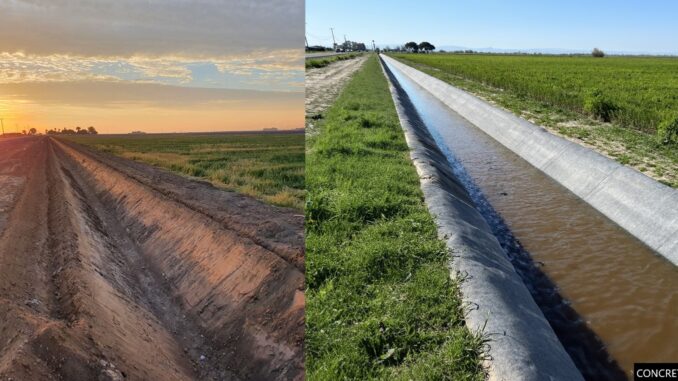

Seepage may be the most visible sign of a struggling canal, but maintenance pressure, erosion and restricted repair windows often reveal a much wider infrastructure challenge.
A recent project in Dos Palos, California, USA, widened the discussion beyond seepage.
.

When water disappears from an irrigation canal, seepage is the obvious concern. But is it the whole problem?
For the engineers and operators responsible for keeping irrigation networks working, water loss is often only the first symptom. Cracked concrete, eroding earth, vegetation growth and repeated local repairs can all reduce performance. At the same time, maintenance teams are being asked to make ageing assets work harder, often with limited budgets and very short periods when a canal can be taken out of service.
That changes the question. It is no longer simply, ‘How do we stop seepage?’ It becomes, ‘How do we improve the canal as a working asset without creating another maintenance problem?’

The challenge behind the visible leak
A canal does not need to fail completely before it begins to affect the wider network. Small defects can lead to soil washout, bank instability and vegetation taking hold. A damaged lining may also require repeated patching, increasing the time crews spend maintaining the same section.
The operational impact matters just as much as the lost water. Every intervention requires people, plant and access. On remote or constrained sites, simply getting conventional materials and equipment to the work area can become a significant part of the programme.
This is why lining decisions need to consider several connected pressures: seepage, erosion, maintenance demand, access, installation time and the speed at which the canal must be returned to service. Treating only the most visible defect can leave the underlying delivery problem unchanged.

What does successful rehabilitation look like?
A canal relining trial in Dos Palos, California, USA, offers one practical example. Henry Miller Reclamation District manages more than 370 miles of main irrigation canals, lateral canals and surface ditches supplying over 47,000 acres of farmland. Much of the network consists of compacted, unlined earth, making water conservation a clear priority.
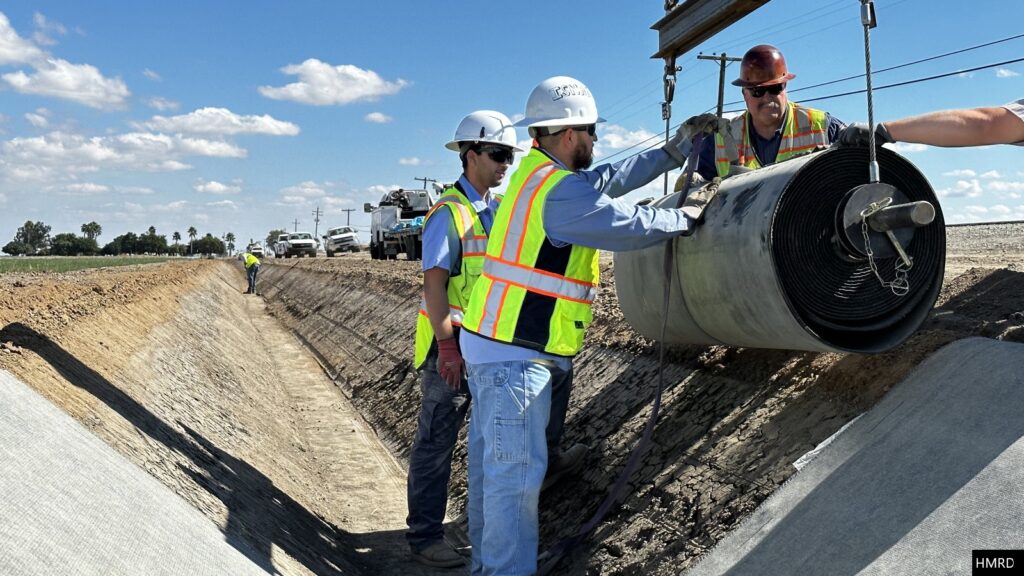
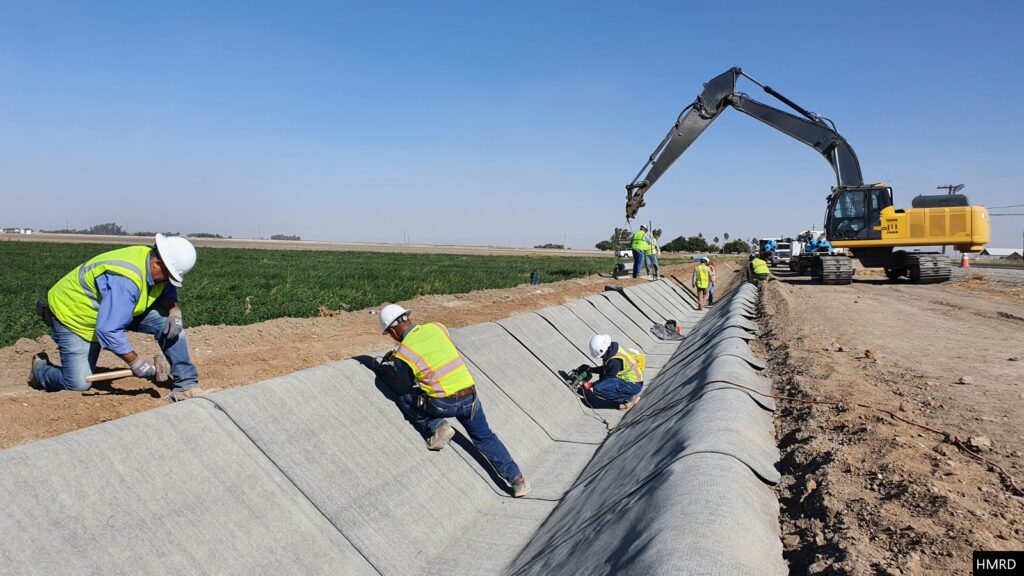
For the trial, a section of cracked and leaking concrete lining was removed and the canal reprofiled. Around 28,000ft² of CCX-M® geosynthetic cementitious composite mat., manufactured and supplied by Concrete Canvas, was then installed in just over four days. The canal returned to service less than 24 hours after installation, and subsequent testing recorded a 96% reduction in seepage.
The figures are important, but so is what made them possible. The lining was supplied in rolls, deployed over the prepared channel and hydrated in place. The district’s own crew could carry out the work using relatively simple equipment, reducing reliance on specialist concrete installation.
Looking beyond the material
Geosynthetic Cementitious Composite Mats, or GCCMs, are flexible, concrete-filled geosynthetics that harden when hydrated to form a durable concrete layer. For canal rehabilitation, their value is not based on one feature alone. It comes from combining erosion protection and a low-permeability lining with a delivery method suited to sites where access, labour and time are constrained.

That does not mean one approach suits every canal. Flow conditions, ground preparation, joints, terminations and anchoring all need to be considered as part of the design. The more useful comparison is therefore not between materials in isolation, but between complete project outcomes: how the lining will be installed, how quickly the asset can return to service and what maintenance it is likely to require over time.
For irrigation authorities facing ageing infrastructure, the first step is to widen the conversation. Water conservation remains essential, but a successful lining programme should also make the network easier to operate and maintain.
Be the first to comment