
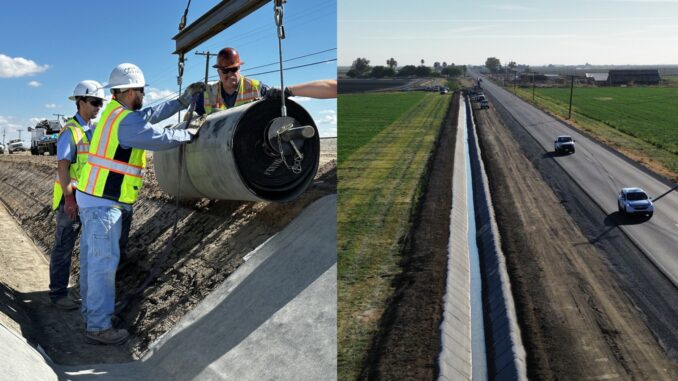

The lowest material price does not always produce the lowest-cost canal repair. A whole-life view can help asset owners decide when relining offers a more practical route than repeated patching or full replacement.

When an irrigation canal begins to deteriorate, is the answer to repair it again, replace it completely or reline what is already there?
It sounds like a simple choice, but material cost is only one part of it. The real comparison includes site access, plant, specialist labour, shutdown time, future maintenance and the consequences of delaying work until the defect becomes more serious.
For asset owners managing long networks and competing priorities, looking at the full delivery model can reveal options that a like-for-like material comparison misses.

When repeated repair stops being economical
Local patching can be entirely appropriate for isolated damage. But where cracking, erosion or seepage is recurring along a section, repeated intervention may become a cycle: drain the canal, mobilise a crew, complete the repair, return the asset to service and then repeat the process elsewhere.
Full replacement can break that cycle, but it may introduce a larger programme, more excavation and additional concrete logistics. On constrained sites, access for mixers, pumps or specialist plant can determine the cost and feasibility before the lining material itself is considered.
Relining offers a third route. By protecting the existing profile rather than rebuilding the entire structure, it may reduce the extent of removal works and help shorten the period for which the canal is unavailable.

Can the maintenance team deliver the work?
The ability to use an owner’s own workforce can materially change a rehabilitation programme. At North Burdett in southern Alberta, Canada, 3,300m² of CCX-M® was installed in under three days. The irrigation district self-performed the installation, helping it complete the work ahead of the irrigation season.
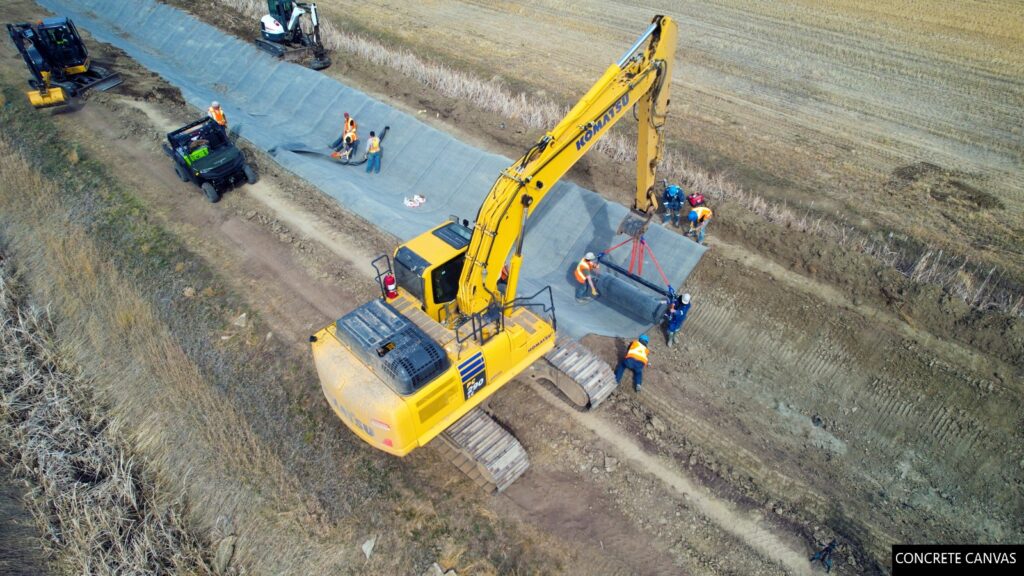
The project had been driven by seepage, deterioration and a fixed operational deadline. Supplying the GCCM in rolls meant it could be deployed, secured and hydrated by the district team without relying on a conventional poured-concrete operation.
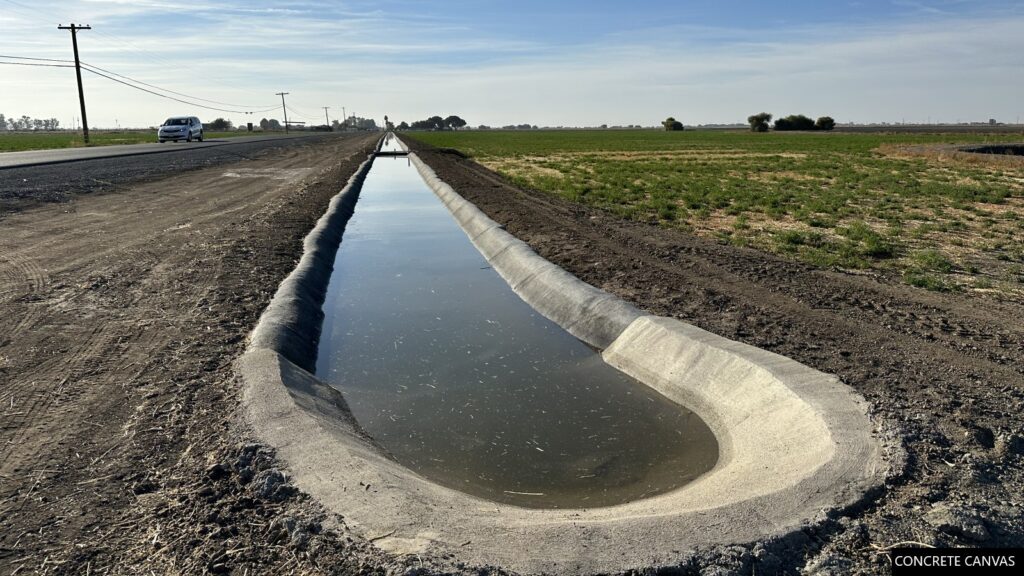
A similar benefit was demonstrated at Dos Palos, California, where approximately 28,000ft² of CCX-M® was installed in just over four days and the canal was returned to service less than 24 hours later. Testing recorded a 96% reduction in seepage. The district highlighted cost, performance, ease of installation and the ability to install with its own personnel as important factors.
Where GCCMs fit
GCCMs combine a geosynthetic structure with a dry concrete mix that hardens when hydrated. They arrive ready for installation, removing the need for on-site mixing and much of the formwork associated with conventional concrete. For irrigation canals, they can provide erosion control, help reduce seepage and create a durable surface over prepared earth or existing profiles.

The solution still needs to be engineered for the site. Designers must consider the condition of the substrate, water velocity, hydraulic performance, jointing, anchoring, terminations and any localised features. Relining should not be used to hide unresolved structural or geotechnical problems.
This is why the best decision is made through early comparison. Rather than asking only which product has the lowest unit cost, teams can compare the plant and labour required, installation rate, operational downtime, expected maintenance and the practical risks associated with each method.
A more useful decision
Repair, replacement and relining all have a place. The aim is not to force every canal into the same solution, but to choose an approach that reflects how the asset is used and how the work can realistically be delivered.
For a short, isolated defect, repair may remain the sensible answer. Where the existing canal is beyond recovery, replacement may be necessary. But when the profile can be retained and the pressures are seepage, erosion, access or limited shutdown time, a GCCM relining system may offer a practical middle path.
Long-term performance is also an important part of that comparison. CCX-M® has a design life of 50 years, giving asset owners a stronger basis for assessing value beyond the initial installation. When that service period is considered alongside reduced maintenance requirements and faster installation, relining can support a more planned approach to managing the network.
Taking that whole-life view can help irrigation authorities move away from reactive maintenance and towards a programme that protects more of the network within the time and resources available.
Be the first to comment