



Hilmar Retief
Principal Solutions Architect at Bentley Systems.
Information Management and Digital Twin Evangelist.
…
For decades, the engineering and construction industry has mastered the art of digital delivery through structured, file-based workflows. The exchange of digital files — DWGs, DGNs, and RVTs — is the bedrock of project communication and contractual handovers. These processes have served us well, providing a reliable framework for delivering complex projects around the world.
As our projects grow in complexity and our 3D models in richness, we find ourselves at an evolutionary crossroads. While the file remains a crucial container for many deliverables, relying solely on file exchanges in a highly dynamic, multi-disciplinary environment can unintentionally create data silos and make it challenging to maintain a single source of truth. The time has come to build upon this foundation by unlocking the vast potential held within our data.
This evolution leads us to a process where we orchestrate a dynamic flow of information through the entire ISO 19650 lifecycle. Instead of just managing static files, we begin building with living data, transitioning toward a truly data-driven process that culminates in the handover of a complete, intelligent, as-built digital asset to the owner.

The Ascent of Data: An Everest Analogy
To understand this shift, imagine the project delivery process as an expedition to the summit of Mount Everest. The ultimate goal — the peak — is the final, verified, as-built model delivered to the owner.
In this analogy, our iModels are the camps established along the route. They are not mere folders; they are sophisticated data-staging areas, each representing a specific level of data maturity and suitability. The data itself is the team of climbers. As climbers become acclimatized and ready for the next challenge, they move up to the next camp. The same is true for our data. It only progresses when it has been verified and is fit for its next purpose.
The Data Journey: From Base Camp to Summit
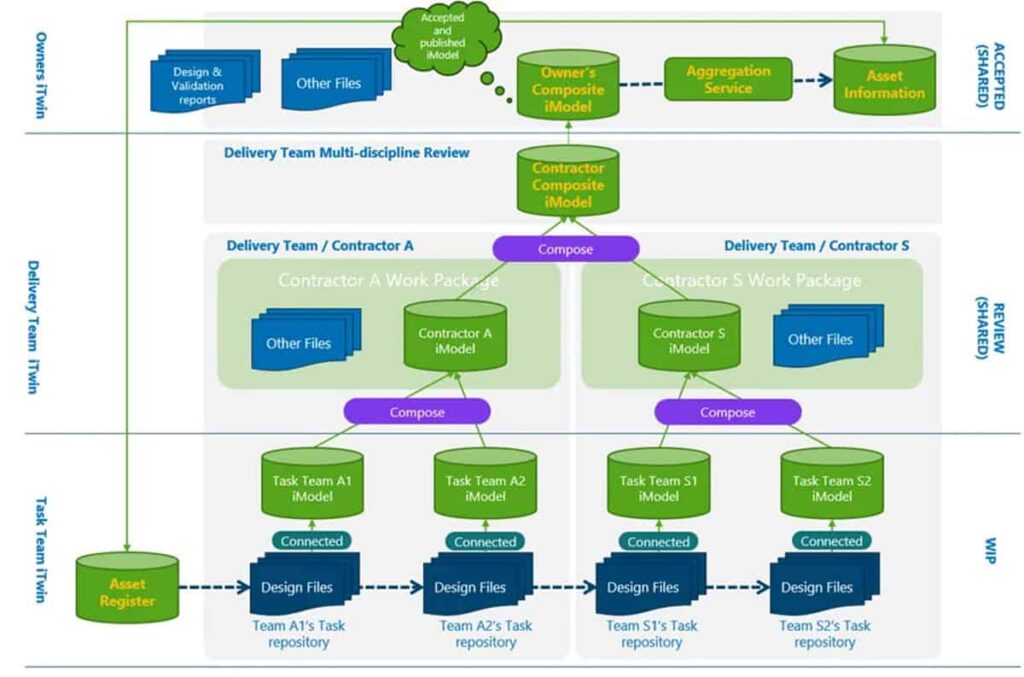
This structured ascent ensures that information is always in the right place, for the right purpose, and at the right level of maturity. Let’s follow the data on its journey from a designer’s desktop to the final owner handover.

Stage 1: The Task Team Base Camp (Work-in-Progress)
The journey begins with the individual designers and engineers working in their native CAD environments — be it Revit, MicroStation, or AutoCAD. These design files (RVTs, DGNs, DWGs) are their digital workbenches.
Crucially, these design files are “connected” to the first staging area: the Task Team iModel. When a designer or a team completes a specific task, they don’t just email a file. Instead, they publish their CAD content into their designated iModel. There is one iModel per task team (e.g., the structural team, the mechanical team), which can contain the composed data from one or many source design files.
This Task Team iModel becomes the exclusive arena for Work-in-Progress (WIP) reviews. The team can visualize their combined work in a shared context, identify conflicts, and refine their designs before sharing them with the wider project.
Stage 2: The Delivery Team Camp (Contractor Consolidation)

Once the internal WIP reviews are complete and the task team is confident in their work, the data is ready for the next leg of its ascent. The data from these individual Task Team iModels is progressed and merged — or composed — into a Delivery Team iModel.
Since task teams are often organized by contractor, this step effectively consolidates a contractor’s entire scope of work into a single, cohesive model. This allows for a higher level of review, ensuring that all a contractor’s systems are coordinated before being integrated with the work of other delivery teams.
Stage 3: The Project Federation Camp (The SHARED State)
This is where the project truly comes together. After the delivery team reviews are finalized, the data from each of the Delivery Team iModels is once again progressed and composed into a single, multidisciplinary, federated project iModel.
This model represents the entire project, integrating the work of all contractors and disciplines into one comprehensive whole. This is the critical “SHARED” step as defined by ISO 19650. Here, multidisciplinary reviews, clash detection, and constructability analyses are performed against the complete project dataset. Reviewers are no longer looking at an isolated piece of the puzzle; they are seeing it in its rightful place within the grand design.
The Summit: The Owner’s iModel (Final Handover)
When all reviews in the SHARED federated model are complete and issues are resolved, the final ascent begins. The project federated iModel is merged into the owner’s federated iModel. This marks the final step in the supply chain review cycle, providing the owner with the complete, verified design for their acceptance.
The New benchmark for delivery
This data-driven methodology is not a rigid, linear process; it is a dynamic and iterative cycle of quality assurance. When a change is required, it is introduced at the source. The designer makes the update in their native CAD file, and the improved data seamlessly begins its ascent through each stage of composition and review. This ensures the owner’s iModel is a living digital asset that always reflects the most current and accurate state of the project.
By building upon our proven, file-based foundations with this data-centric approach, we create a definitive single source of truth. We foster a more collaborative environment and, ultimately, deliver not just a set of drawings, but a valuable, intelligent digital twin; a project model that will serve the owner for the entire lifecycle of the asset. The future of engineering is here, and it’s built on a foundation of data.
First published on the Bentley Systems Blog
Be the first to comment