


Ian Fraser
Technical Director at TCS Geotechnics
A geotechnical engineer and geosynthetics specialist with almost 40 years of industry experience, much of that with global geosynthetics manufacturers, designers, and suppliers.
…
As well as being Technical Director at TCS Geotechnics, I also chair the BSI technical committee overseeing UK National standards development related to geosynthetics (B553), and I play an active role in the complementary work at the European (CEN) and International (ISO) levels.
In respect of the work undertaken in ISO, I want to highlight the recent publication of the long-awaited ISO Technical Report TR 18225-5:2025, ‘Design Using Geosynthetics—Stabilisation’.
This document is specifically aimed at designers and specifiers, and I would strongly encourage those of you involved in geotechnical and civil engineering design to acquire a copy and digest it as soon as possible. While this may not sound like a page-turner, I can assure you that the creation of this document took an enormous effort and was anything but dull, and the document itself is packed full of useful information and guidance—most of which I don’t believe has ever been collected in one place previously.

A range of views and approaches are represented with the intent to inform designers and give them some measure of choice in their approach.
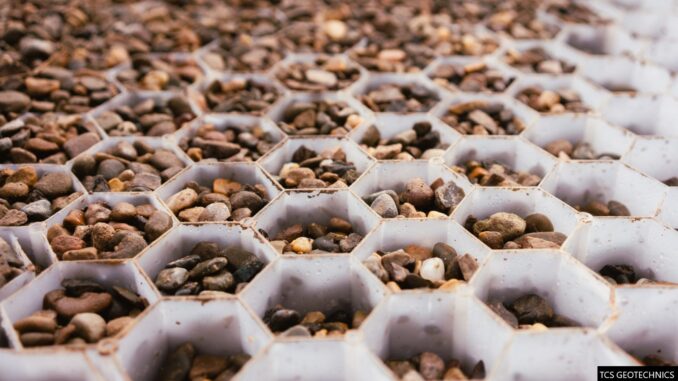
Stabilisation is an extraordinarily powerful geosynthetic function that is vastly underutilised. I say this because the financial and environmental savings available are typically enormous, and I am confident that the inclusion of geogrids and geocells in infrastructure projects represents a very small fraction of the instances where they would bring significant benefit.
In the highways sector, we are talking about savings of up to 50% in aggregate thickness in unbound layers and similar significant potential savings in asphalt thickness. These reductions carry with them huge environmental benefits related to reduced quarrying, transport, and placement of materials.
Additionally, the potential reduced on-site excavation and disposal benefits (including minimising landfill tax) that thinner construction layers provide can be significant. Furthermore, initial financial and environmental cost savings aren’t the only option. Instead, designers can opt to lengthen design life and take the associated long-term economic and sustainable benefits of reduced renewals and maintenance or combine the two approaches, balancing the two philosophies and taking some initial savings while creating a more limited design life extension.

I am sure that some of you are reading this thinking, ‘If this technology is so great, then why is it so underutilised?’ and that’s a valid question. Some of the answers are as follows:
- Lack of education and understanding. This is exactly what the technical report is intended to address. Unfortunately, as a result of crammed curricula, this level of geosynthetic design is generally not taught in undergraduate courses in universities, so by the time young designers start work, it’s easier for them to follow so-called ‘traditional’ construction methods than learn something new.
Unfortunately, just because these ‘traditional methods’ have been around for a long time clearly doesn’t mean that they offer the best economic or environmental solutions. I would encourage designers, young and old, to step beyond what is considered ‘traditional’ and embrace solutions that can often provide better results. - Viewed as a new-fangled technology. This is simply incorrect. The first stabilisation geogrids became commercially available in the early 1980s. This technology is nearly 50 years old and has been tested, proven, and utilised successfully across the world for decades.
- Not accepted for public bodies because most of R&D has been undertaken by commercial organisations. This has been quoted to me as a reason more than once, and it’s frankly a strange and rather outdated argument.
Do government departments refuse to use software developed by Microsoft? Do hospitals refuse to use drugs developed by Roche or Bayer? The fact is that the majority of key technological breakthroughs are driven by commercial organisations because they are principally the ones who will invest in the R&D.
You can perhaps tell that I have some passion about this topic. I can assure you that my enthusiasm is not commercially driven; I don’t care whose product you specify or purchase. In what is the twilight (maybe even later) of my career, any potential increase or decrease of geosynthetics sales will have no discernible effect on my pocket.
I simply abhor the thought that there are huge environmental benefits available that are not being realised through lack of awareness or dogged resistance to anything that is perceived as new—even though it’s 50 years old.
Please take a look at the report referenced above and take advantage of the benefits offered by geosynthetic stabilisation on your next project.

Be the first to comment