
Three contractors will share a £968 million National Highways framework for the delivery of concrete roads reconstruction schemes.
The Legacy Concrete Roads Reconstruction (LCRR) framework, which has a duration of six years (2026-2031), includes:
- design and subsequent construction services for:
- demolition of existing concrete pavements,
- reconstruction of pavements (including new pavement furniture and markings)
- design and delivery of associated temporary traffic management solutions,
- when instructed:
- involvement in optioneering,
- design and construction of alterations to those legacy assets which interface with the replacement pavements’ designs, which may include sub-surface drainage, street furniture and its foundations and signage,
- design and construction to replace legacy central reserve with a hardened solution and overlay legacy concrete pavement with a long-life pavement solution (including new pavement furniture and markings),
- performing principal designer and principal contractor duties as defined under the “Construction (Design and Management) Regulations 2015” (“CDM Regulations 2015”)
- carbon capture recording and reporting,
- recovery, recycling and reuse of arisings during the delivery of a scheme,
- engagement with all identified stakeholders, and
- identification, recording and realisation of programme efficiencies.
The three successful companies, out of seven that bid, are:

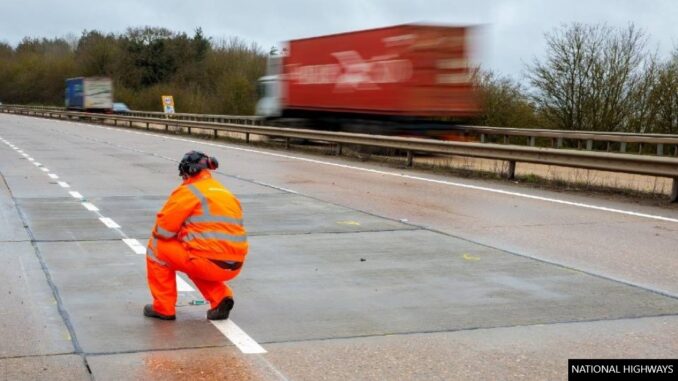
Most of England’s strategic road network is surfaced with asphalt, also known as blacktop or tarmac. However, some roads are built of concrete. These make up around 400 miles (4%) of England’s motorway and long-distance A-road network.
Most concrete roads are located along the eastern side of England, in the North East, Yorkshire, East Anglia and the South East. There are also small stretches in the West Midlands, Merseyside and Greater Manchester.
The majority of these concrete roads were built in the 1960s and 1970s. Back then, traffic volumes were half what they are today. Concrete roads have proved tougher and longer lasting than asphalt. Over the years they’ve needed very little maintenance.
But after decades of safe use and hundreds of millions of journeys, these roads are nearing the end of their working lives. They need vital upgrades to stay safe, dependable and durable. Better surfaces will also boost ride quality and reduce noise for many years to come.

The National Concrete Roads Programme will ultimately replace existing concrete roads with modern roads meeting current standards. It will take many years to achieve this, and National Highways’ main task currently is to prioritise which sections need to be replaced first. At the same time, the remaining roads will be maintained to extend their life.
When a section is prioritised for replacement, a full depth reconstruction is carried out, replacing the entire road to current standards. Several full depth reconstruction schemes have been delivered, including:
- the A11 at Spooner Row
- the A12 Marks Tay and Margaretting
- the A14 at Haughley
Other schemes have been completed that extended the life of existing concrete roads, like the A46 Six Hills.
Nick Knorr, head of the National Concrete Roads Programme, said: “The national concrete roads programme is a critical long term strategic programme of renewals for National Highways, ensuring our roads are safe and reliable for drivers, maximising the benefits of this significant investment in the future of England’s motorways and major A roads.
“By replacing aging concrete roads with modern designs, we’re ensuring smoother, quieter, and more resilient routes for millions of people.

“Building on the success of recent reconstruction schemes, this next phase will be delivered in partnership with our supply chain, helping us bring lasting improvements to communities and businesses across England.”
Be the first to comment